All Posts

Peter “Pete” McNab

As an older boy young teenager in the early to mid-seventies I was fiercely loyal to the players drafted by the Sabres and one such player was Peter McNab who my boys selected in the sixth round 85th overall during the 1972 NHL amateur draft (also drafted by the New York Raiders of the WHA that same year).

It was different to see an American college player drafted by Buffalo Mr. McNab played for a Denver team in the WCHA consistently scoring more points than games played and fortunately for the Sabres after Mr. McNab entered Denver on a baseball scholarship he ultimately made the Men’s Hockey team.

Mr. McNab is best known for his eight seasons as a Boston player scoring 30 to 40 goals for six consecutive years while contributing to two Stanley Cup Finals runs, he also spent parts of two seasons with Vancouver and the New Jersey Devils.

I fondly remember Mr. McNab as one of the players contributing to Buffalo’s magical Cup run during the 74-75 campaign as a solid 20 goal scorer that chipped in a couple of goals and a half-dozen assists during the playoffs.

As a younger fan, I could not fathom why the following season when the Sabres stalled in the Quarter Finals the two times 20 goals scorer Mr. McNab was traded away the next year for a player that in three full seasons in Boston could not crack 20 goals.

Interestingly the trade between Buffalo and Boston was the first time in NHL trade history where two unsigned UFAs were traded, signed, and played for the team they were traded to.

Mr. McNab played in three Stanley Cup Finals during the 1970s with Buffalo and Boston and his father Max McNab won his Stanley Cup as a Detroit Red Wing in the 1950s and was the General Manager in New Jersey when his son Pete was signed as a free agent.

One of the least penalized players in the 1970s during an era of bench-clearing brawls and competing against teams with roving “policemen” that “enforced” player safety, Mr. McNab earned four penalty minutes in 79 games during the 1977-78 season garnishing him second place in the Lady Byng voting.

Astonishingly during the 1979 season when this two time Lady Byng finalist would earn 10 PIMs all year gets himself suspended six games the day after Christmas for going into the stands and fighting Rangers fans in Madison Square Garden.

Behind the scenes Owners, General Managers, Coaches, Scouts, Agents and other associates determine the fate of the players, their contracts and ultimately where and who they play for, but this long ago young naïve fan sadly could not understand why this player had to be traded?

Unheralded Hajt

NHL.com

In the first three rounds of the 1971 NHL amateur draft, the Buffalo Sabres selected Rick Martin, Craig Ramsey, and in the third round selected defenseman William Albert Hajt who chose to attend the University of Saskatchewan instead of accepting Buffalo’s contract offer to play in the 1971-72 season.

Bill Hajt was a left-hand shooting, 6-3, a 215-pound defenseman that after leaving the University he played the next two seasons in the AHL for the Cincinnati Swords where he contributed to winning the AHL regular-season title and Calder Cup championship in 1973.

Rookie OPC card

During the 1973-74 season, Mr. Hajt finished up at the AHL level and played six games for the Sabres that year collecting a couple of assists.

During Buffalo’s amazing run to the Stanley Cup Finals of 1974-75, Mr. Hajt was a quiet and underrated solid, stay-at-home, defensive defenseman who finished the regular season with almost 30 assists and a plus 46 rating.

Rookie Mr. Hajt scored the Sabres fourth goal to tie the third game of the Cup Finals which became Buffalo’s first Stanley Cup Finals victory, the following season Mr. Hajt set the Buffalo record with four assists by a defenseman in a regular-season game.

NHL.com

Mr. Hajt was named to the 1981 Wales Conference All-Star in Los Angeles but refused to play in it so he could “rest-up” for the second half of the season he missed his next All-Star nod in 1985 due to a shoulder injury.

Mr. Hajt led Buffalo twice in plus/minus rating and at retirement owned the Sabres record for career games played by a defenseman, was selected twice for the honor of the Tim Horton Memorial Award (unsung hero), and once for the Charley Barton Memorial Silver Stick Award (dedication to the game).

He retired once in 1983 while in camp, left for home, came back stating that it felt like being in a “morgue” and felt bad about leaving the Sabres shorthanded and coming back to play for four more seasons.

NHL.com

Mr. Hajt’s son Chris played six NHL games for Edmonton and Washington while mostly playing at the AHL level, and a few European leagues before coming back to the OHL, AHL, and NHL to coach, where he was an assistant coach for the Sabres during the 2017-18, 208-19 seasons.  

As a young boy/teenager most of the 1970s Buffalo Sabres were my Hockey Heroes and number 24, big and lanky Bill Hajt was no exception, and as I grew so did my appreciation for defensive play and players.

Everyone appreciates a flashy Dahlin or Housley skating in on a goaltender and scoring but it is reassuring to have a stay-at-home defensive defenseman that every coach at every level wants and requires for their team’s success.  

January 9th, 1989 Sabres vs Soviets

To put into perspective my timeline it was during December 1979 and I was at boot camp when the USSR invaded Afghanistan.

Then fast forward to a Monday evening January 9th 1989 and I was in the Memorial Auditorium watching the Buffalo Sabres defeat the Central Red Army team in OT only a month before the USSR pulled their forces out of Afghanistan.

Also, the Buffalo Sabres draft-pick a Lt. in the Central Red Army Mr. Mogilny was four months from defecting from the USSR via Stockholm to Buffalo to join the Sabres in early May of 1989.  

While heading into the Aud (Buffalo Memorial Auditorium) someone handed me what I thought at the time was some more Hockey information because of the two team’s rosters printed on the back of a folded single sheet of paper.

Later at home, I read the title, “The Puck ‘N’ Red Army…they shoot as well as they skate.” On the inside, it listed the Red Army atrocities from 1917 to the 1979 invasion. It was put together by the Ukrainian Congress Committee of America and the Ukrainian Student Organization of Michnowsky.

Two other artifacts remain with me, the NHL published their own single-page folded sheet of paper that was larger and glossy ironically both papers had mistakes and omissions.

Additionally, I still have an oversized pin-back button manufactured in 1988 by a now-defunct Buffalo Business named Trench, and that has the dates and the words, Soviet Super Series ’88-’89, January 9, 1989.

The NHL and NHLPA billed this as the NHL Super Series, NHL Teams vs USSR 1988/89, and on television, here along the Lake, it was titled, Super Power Face-Off with the winner being presented with the Friendship Cup trophy provided by SportsChannel America.

I was a teenager when Buffalo twice beat the mighty Soviets 12 – 6 and 6 – 1 during the icy Cold War years of the 1970s. I take some pride in that the Buffalo Sabres are the first NHL team to defeat the Soviets.

When I was a young bartender in the mid-1980s the Buffalo Sabres lost a horrible game on January 6, 1986, a 7 – 4 score to the Soviets during the 1985-86 Super Series.

Right after Christmas December 26, 1988, the Soviet Super Series ’88 – ’89 began with a tie in Quebec and ended January 9, 1989, in Buffalo.

The Soviets were 6 – 5 – 2 as they rolled into Buffalo to play their last game of the series and it was the 4 – 1 – 1 CSKA Moscow team that the Sabres faced.

Soviet roster has many future NHLers

After the Soviets scored the first goal of the game the Sabres went ahead 4 – 1 on goals by Captain Mr. Foligno, newly acquired Mr. Vaive, Mr. Hogue, and future HC Mr. Ruff, the Soviets fought back and forged a tie game to end the second period.

Early in the third period on the PP, the Soviets tackle Mr. Ruff at the blue line essentially giving the Soviets a four-on-three advantage opening up a Soviet defenseman who scores his second goal of the game to give the Central Red Army the 5 – 4 lead.

A few minutes later Mr. Sheppard knocks the puck away from a Soviet forward near the center ice circle and skates in all alone going backhand forehand four or five times until he slides it under the goalie with the forehand to tie the game.

The third period finishes tied giving the Sabres an opportunity to win the game in OT and tie the Soviet Super Series for the NHL which they do spectacularly.

Not long into the overtime session Mr. Housley carries the puck into the Soviet zone along the dasher boards and gets the puck deflected to the front of the net where rookie Mr. Priestly gets control of it to incredibly score the winner 2:20 into the overtime.

It happened because during the Sabres rush into the Soviet zone Mr. Priestly was grabbed by the head and neck area and spun around down to the ice inside the blueline well away from the play.

Mr. Priestly rose and skated deeper into the Soviet zone when Mr. Housley played the puck off the backboard behind the net and shot it off a Soviet defender to the side of the goaltender deflecting it towards Mr. Priestly in front who snapped it home.

Along with Mr. Mogilny, there was another future Buffalo Sabres player on that Soviet squad who did play that night, Left Wing Yuri Khmylev.

I had often wondered if the Soviets that game had more motivation to play well and beat that Buffalo team in 1989 because of USA’s Gold Medalist (1980 Miracle on Ice) Sabres defenseman Mr. Ramsey.

I attended this game over three decades ago and can remember some of the experience so I am appreciative that YouTubers have provided videos to look back with nostalgia and assist this Hockey Historian’s memory.  

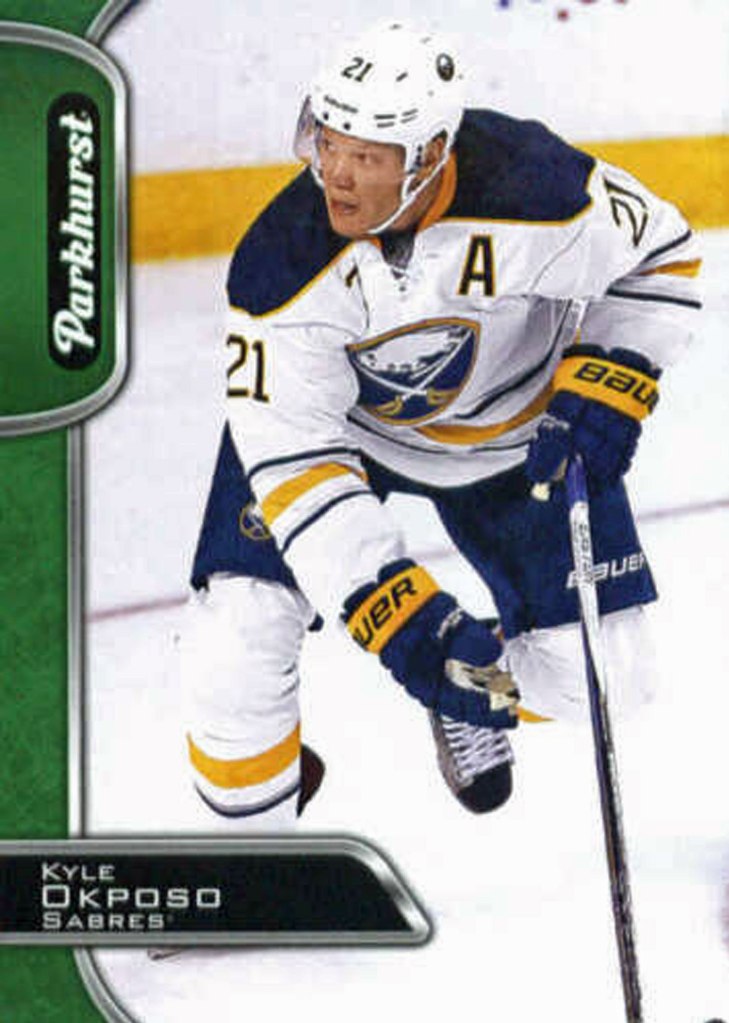
Lee “Fogey” Fogolin Jr.

I cannot write about one of my favorite Sabres defenseman from the mid to late seventies without mentioning his father and the other noteworthy father and son NHLers involving the Sabres.

Lee Fogolin Sr. and Lee Fogolin Jr. (Sabres) both Stanley Cup Champions

Mike Foligno (Sabres) and sons Nick, Marcus Foligno (Sabres)

Michael Nylander and sons William, Alexander Nylander (Sabres)

Interestingly two of the Sabres father and son examples have last names that are anagrams of each other Fogolin / Foligno and it is the only time that has happened in the NHL.

Lee Fogolin Jr. the son of Stanley Cup Champion Red Wing Lee Fogolin Sr. was eligible to be drafted in 1974 as an underage player because the NHL decided it was fine to draft one underage player in round 1 or 2 that season.

When Buffalo selected Lee Fogolin Jr. in the first round 11th pick, that selection became the first American born player to be drafted in the first round.

Defenseman Lee Fogolin Jr., although the “Jr.” was not used when the games were being broadcasted on radio or television because his father was no longer playing in the NHL and was coaching in the USHL.

To this day Hockey websites like, “Hockey Data Base and Hockey Reference” do not use the JR or SR designations they just list the years both have played but do mention the family relationship.

Buffalo’s regular season in 1974-75 was injury filled for Mr. Fogolin Jr. who had an injured left eye and bone chips in his wrist but played 50 games and earned 2 goals with 2 assists with a plus 1 rating.

During Buffalo’s amazing Stanley Cup run in 1975, the Sabres utilized Mr. Fogolin Jr. as a forward during the penalty kill.

In the next season, Mr. Fogolin Jr. had split time between the AHL and NHL and still was able to contribute in the playoffs for Buffalo.

The next four seasons Mr. Fogolin Jr. was a rock-solid defenseman that earned around 20 points a season on average, he was indeed the prototypical NHL defenseman at six feet and 200 pounds.

When the NHL held its expansion draft there were three Sabres players who were unprotected and selected by three of the four WHA teams entering the 1979-80 NHL season.

Two Buffalo players selected, Terry Martin by Quebec and Dave Given by Hartford were of no consequence to me or my beloved Sabres.

The one expansion draft selection that hurt my heart was when Buffalo’s worst GM in its history left Mr. Fogolin Jr. unprotected affording the WHA Oilers an opportunity to select him.

Mr. Lee Fogolin Jr. was so respected he was the Oilers Captain for approximately three seasons before “giving it up” to wayne because Mr. Fogolin Jr. thought that would help Edmonton win the Cup, and it did.  

In an effort to repair some of the damage the next GM after the worst GM in Buffalo’s history departed, Mr. Meehan brought back Mr. Fogolin Jr. to play for the Sabres, but nine games and eight years too late for Buffalo.

When he retired Mr. Fogolin Jr. moved back to Edmonton where he is best remembered and had the most NHL success, but for this teenager from the 1970s, “Fogey” will always be in Blue and Gold.

Daring Danny Gare

One of Buffalo’s more prolific goal scorers in Sabres history is British Columbia native Daniel Mirl Gare who at 5’ 9” and approximately 180 lbs soaking wet was also one of the Sabres toughest and most fearless players.

While playing for the WCHL Calgary Centennials, the scoring and fighting Mr. Gare amassed 127 points in 65 games along with a whopping 238 PIM in his final season in major juniors.

Drafted by Buffalo and Winnipeg in 1974 Mr. Gare was selected in the first round 11th overall in the World Hockey Association’s “Secret Amateur Draft“. Fortunately for Buffalo, Mr. Gare was selected in the public NHL Amateur Draft in the second round 29th overall.

In his rookie season, Mr. Gare scored 31 goals and 31 assists and contributed seven goals and six assists in 17 playoff games as Buffalo marched to the Cup Finals. Watching the 1975 Cup Finals was exhilarating and to witness  Mr. Gare holding his own fighting against the bigger broad street bullies main goon dave schultz was incredible.  

A dramatic goal scorer Mr. Gare scored on his first shot on his first shift of his first game only 18 seconds into the first game of the 1974-75 Season. The following year Mr. Gare scored 50 goals but not until he scored a Hat Trick in the final game of the 1975-76 Season along with earning 129 PIM and again over a plus 30 rating for the year.

Mr. Gare finished third in the Calder Memorial Trophy voting and that season’s winner had already played 23 games the season prior to his “rookie” season. You can observe how close the top three rookies were in scoring but what stands out like an empty net is how Mr. Gare garnished a plus 39 rating compared to single digit plus earners of that season.

Although a back injury limited Mr. Gare to 35 games and 26 points in his third season, after recovering his following seasons were some of the best statistically of his career.

Then after scoring 56 goals and 46 goals for two seasons Mr. Gare’s last Sabres season in 1981-82 lasted 22 games and he scored 21 points before arguably the worst general manager in Buffalo history sucker punched the fan base by trading away Mr. Gare and beloved Mr. Schoenfeld.

The NHL ALL-STAR Game in 1979-80 featured Mr. Gare along with teammates Mr. Schoenfeld and Mr. Edwards.

Mr. Gare was a fighting 20 goal scorer for Detroit for approximately four and half seasons before playing his last 18 NHL games for Edmonton in 1986-87.

Suspended three times in his career Mr. Gare was suspended once for the first game of 1977-78 season because he left the bench (penalty box) to join a brawl in a preseason contest versus Boston.

Mr Gare was an assistant coach for Tampa Bay for two seasons in the early 1990s before becoming a color analyst for both Buffalo and Tampa Bay over the seasons.